Quality Control Checkpoints in Custom Perfume Manufacturing
Quality control in fragrance manufacturing is not an inspection at the end of the line; it is a series of gates, and the earlier ones catch the expensive problems. A concentrate that is wrong at compounding cannot be repaired by better filling, and a component that does not seal cannot be fixed at the packing table. Brands that specify where the checks happen, who performs them and what result is acceptable get far fewer surprises than brands that ask whether the factory has quality control at all.
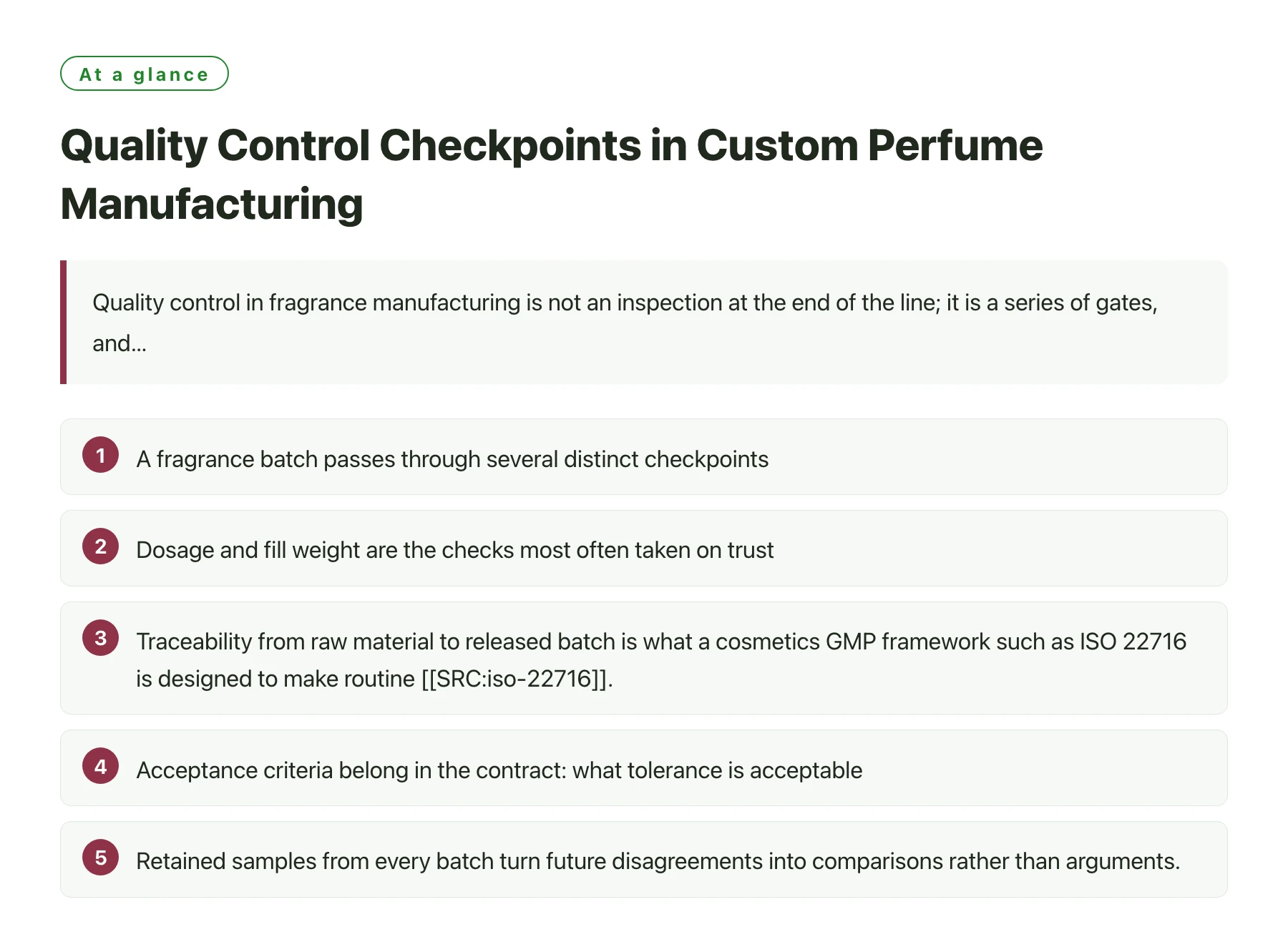
Key takeaways
- A fragrance batch passes through several distinct checkpoints, and problems caught at compounding are cheaper than the same problems caught after filling.
- Dosage and fill weight are the checks most often taken on trust, and they are the easiest to verify with a documented sampling plan.
- Traceability from raw material to released batch is what a cosmetics GMP framework such as ISO 22716 is designed to make routine [1].
- Acceptance criteria belong in the contract: what tolerance is acceptable, who inspects, and what happens to a batch that fails.
- Retained samples from every batch turn future disagreements into comparisons rather than arguments.
Most first-time buyers experience quality control as a question on a supplier form — do you have a quality system, yes or no. That answer says very little. What determines whether a brand receives a consistent product is the placement of the gates and the discipline applied at each one.
The checkpoints below are the ones that matter most in fragrance production. They are described in the order they occur, because the order is also the order of cost: a defect is cheapest to fix at the first gate and most expensive at the last.
Why the first gate decides the rest
Fragrance is a small-volume, high-value concentrate diluted into alcohol or another carrier and filled into packaging. That structure means most of the value is created early and most of the risk is created early too. If the concentrate is compounded to the wrong formula version, no downstream check will recover the batch, because the error is distributed evenly through every bottle.
Good practice at the first gate is unglamorous: materials verified against specification on arrival, components checked for dimensional and material conformity, and a compounding record that identifies exactly which version of the formula was used. This is where traceability earns its keep, and it is the reason a management framework built around documented production matters more than a certificate on a wall [1].
The first gate has a compliance dimension as well. The concentrate has to be checked against the material use limits that apply to the product and its category, not only against the approved reference, because those limits define what the formula is permitted to contain [2]. Both checks belong at the same point, since both depend on the same record and the same frozen formula version.
The question that reveals whether the gate exists
Ask to see one compounding record and follow it back to the material lot numbers used. If the chain is complete, the plant runs traceability as a routine; if it cannot be reconstructed, the first gate is nominal. This single request tells a brand more about quality control than any questionnaire.
The five checkpoints that matter
- Incoming materials and componentsRaw materials, alcohol, bottles, pumps, caps and cartons are checked against specification before they enter production, with lot references recorded.
- Bulk concentrate after compoundingThe compounded concentrate is assessed against the approved reference for odour, appearance and physical parameters before any filling begins.
- Filling and dosageFill weight or volume is checked on a sampling basis through the run, together with the concentrate-to-carrier ratio, which is where an undetected drift shows up as inconsistent strength.
- Assembly and decorationSeals, spray function, actuator alignment, label placement and print quality are checked on assembled units rather than on components alone.
- Finished goods and retentionReleased units are inspected against the agreed criteria, and a retained sample from the batch is sealed, labelled and stored by both parties.
Where common problems are caught, and why they happen
| Problem | Gate that catches it | Usual root cause |
|---|---|---|
| Scent does not match the approved sample | Bulk concentrate assessment | Wrong formula version, or an unapproved substitution |
| Strength varies between bottles | Filling and dosage | Dosage drift, or concentrate not fully homogenised |
| Leaks or poor spray performance | Assembly inspection | Component incompatibility with the concentrate |
| Label or print defects | Assembly and decoration | Artwork approved after the print run started |
| Fill weight below specification | Filling and dosage | Machine calibration drifting during a long run |
| Dispute about what was approved | Retention | No sealed reference sample held by both parties |
Notice how few of these are perfumery problems. Most production failures are process failures, which is why the checkpoints are about records and tolerances rather than about noses.
Writing the checkpoints into the contract
Write the acceptance criteria before the first order, not after the first complaint. Fill weight tolerance, odour match against the retained reference, seal integrity and print accuracy are all definable in advance, and a batch that fails a written criterion is a commercial event with a defined remedy rather than an argument.
Quality language in a manufacturing agreement often reduces to a sentence about conforming to specification, which leaves the practical question open: specification defined how, and inspected by whom? It is worth replacing that sentence with a short schedule that names each gate, the check performed, the sampling basis and the record produced.
The schedule also needs a failure clause. What happens when a batch fails a check — rework, replacement, or rejection with the deposit handled in a stated way — should be agreed while both parties are still optimistic. That is not pessimism; it is the mechanism that makes the acceptance criteria real.
The same discipline applies to the components, which are a frequent source of disputes because they sit between two suppliers. If a custom perfume manufacturer in China assembles the product but the brand sources bottles separately, the incoming inspection step has to be defined for both, and responsibility for a defective component needs a named owner.
It is also worth asking what the factory does with a batch that is borderline rather than clearly wrong. A plant that documents the decision and holds the batch for the brand's judgement behaves differently from one that releases it and mentions it later. The habits described in quality control in luxury fragrance production apply to premium ranges for the same reason they apply to any range: the cost of a recall or a reformulation is far higher than the cost of a pause.
Auditing the system without auditing the factory
A brand does not need to run a full audit to get most of the benefit. Reviewing one batch record, one compounding record and one retained sample covers the first, second and fifth gates, and those three documents answer the question a full audit is intended to answer — whether the process is repeatable — at a fraction of the effort.
What a retention programme is worth
A retained sample costs almost nothing and settles most quality conversations. The discipline is simple: a sealed unit from each batch, labelled with the batch number and date, stored under conditions that do not degrade it, and held by both the manufacturer and the brand.
Retention becomes more valuable as a range grows. When a formulation is adjusted, a component supplier changes, or a market asks a question about an earlier shipment, the retained sample is the evidence. It also supports the safety side of the file: where an ingredient in the formula raises a question that requires assessment, the ability to show exactly what was in a given batch is part of answering it [3].
For a brand building a range, that habit pairs naturally with a preference for suppliers whose process is inspectable rather than merely certified. A fine fragrance manufacturing partner that treats retention and batch records as standard is easier to grow with, because the questions get harder as volumes rise, not easier.
Sources
- ISO 22716 (Cosmetics GMP)
- IFRA Standards Library (International Fragrance Association) —— The IFRA Standards Library lists the restrictions the fragrance industry applies to individual fragrance ingredients, based on safety assessments; it is the reference point for compliant fragrance formulation.
- EU Scientific Committee on Consumer Safety (SCCS) —— The EU scientific committee that issues opinions on the safety of cosmetic ingredients, including fragrance allergens and their labelling thresholds.
Frequently asked questions
Does a perfume factory need to be certified for a brand to trust it?
Certification shows that a quality system has been audited against a standard, which is a useful signal. It is not a substitute for looking at a batch record and a retained sample, because those show what happens on an ordinary production day.
How many units should be sampled during a filling run?
The sampling basis should be written into the agreement rather than assumed, covering the start, middle and end of the run plus periodic checks throughout. The point is to detect drift while the run is happening, not to inspect a finished pallet.
What should be in a retained sample?
A sealed finished unit from the batch, labelled with the batch number, production date and formula reference, stored so that it does not degrade, with one copy held by the manufacturer and one by the brand.
Who pays when a batch fails inspection?
That depends entirely on the contract. Rework, replacement and rejection should each have a stated consequence, including how the deposit and any components already consumed are treated. Agreeing the remedy in advance is what makes a failure clause usable.
Can quality control catch a scent that differs from the approved sample?
The bulk concentrate assessment is designed to do exactly that, by comparing the batch against the retained reference. Its accuracy depends on the reference being sealed and stored properly, which is why retention is a quality activity rather than an administrative one.