Furniture-Grade Panels for Large-Scale Fit-Outs
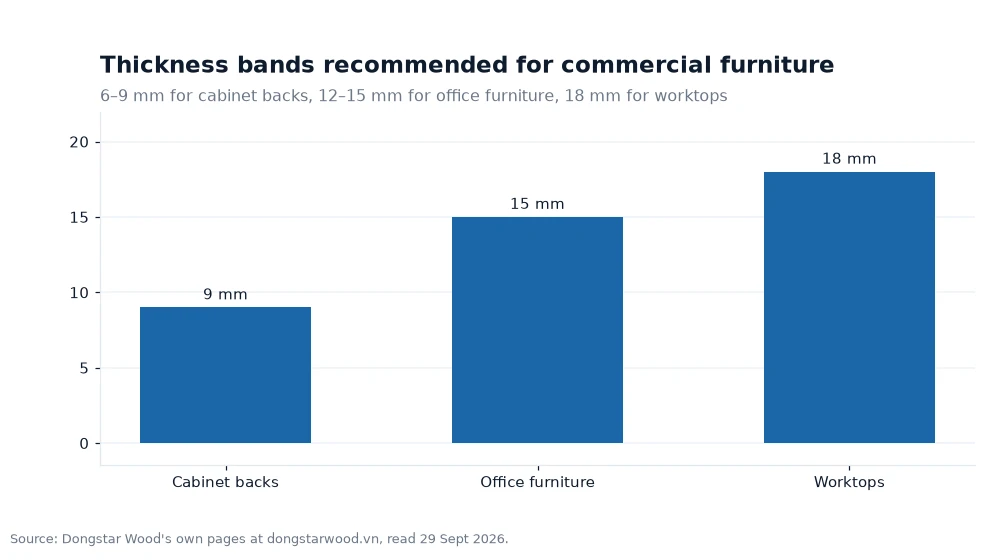
A hotel or office fit-out locks in three thickness bands long before the first panel is cut: 6–9 mm covering cabinet backs plus drawer bottoms, 12–15 mm for shelves, wardrobe carcasses and hotel fixtures, and 18 mm for worktops and structural panels. Buying all three from one mill keeps the face veneer, the glue class and the batch record consistent across a programme that runs for months.
Key takeaways
- Three bands cover most fit-out work: 6–9 mm backs, 12–15 mm shelves and fixtures, 18 mm worktops and structural panels.
- Contractors often standardise on 12 mm and 18 mm so a single sheet stock serves several trades.
- Match glue to service: MR for dry interiors, BWR where humidity and light water exposure are expected.
- The category page leads with a No Anti-Dumping Tax position for the EU market, which belongs in the landed-cost sheet from day one.
Why fit-out programmes buy in bands, not single thicknesses
A fit-out is a sequence of trades rather than one product. Cabinet backs, drawer bottoms and partitions carry no load and want the lightest panel that stays flat. Shelves, wardrobe carcasses and hotel fixtures take daily abuse and need stiffness. Worktops and structural panels need thickness for edge fixing and screw pull-out. Buying all of it from one source removes the colour and grade drift that appears when three suppliers describe beech, poplar and birch faces as though the words were interchangeable.
The commercial argument runs the same way. A mill that describes itself as supplying furniture plywood, hardwood plywood and veneer plywood under one roof can quote a whole bill of panels, which keeps the veneer batch, the glue system and the thickness tolerance inside one production record instead of spreading them across three purchase orders. The manufacturer's own Commercial Plywood page lists four core builds and five face veneers, and sets out six reasons European buyers give for repeat orders: cost position, stable monthly supply, quality control at each production stage, customisation, wholesale pricing, and order sizes that flex from project to project.
The thickness bands behind furniture programmes
Published guidance from the manufacturer sorts the bands by job rather than by fashion. Cabinet backs, drawer bottoms and partitions sit at 6–9 mm. Office furniture, shelving, hotel fixtures and general joinery sit at 12–15 mm. Heavy-duty furniture, worktops and structural panels sit at 18 mm. Contractors running long programmes frequently standardise on 12 mm and 18 mm simply because those two cover most of the cut list and simplify the store.
Cutting plans deserve the same attention as the thickness list. A 1220 × 2440 mm sheet gives 2.98 m² and a 1250 × 2500 mm sheet gives 3.125 m², a difference of 0.145 m² per sheet, but the larger format carries a 2500 mm run in one piece, which is what a wardrobe gable wants. Where a programme mixes formats, keep them separated in the store so a fitter cannot reach for the wrong one on the morning of a handover.
| Panel job | Thickness band | Why it is chosen |
|---|---|---|
| Cabinet backs, drawer bottoms, partitions | 6–9 mm | Flat, light, no structural duty |
| Office furniture, shelves, hotel fixtures | 12–15 mm | Stiffness with manageable panel weight |
| Heavy-duty furniture and worktops | 18 mm | Edge fixing and screw holding |
| Standardised site stock | 12 mm and 18 mm | Two formats cover most of the cut list |
Faces, cores and what actually moves the price
Face veneer options published for commercial work include Birch, Pine, Bleached Poplar, EV and Rose Eucalyptus. Cores run through Acacia Core, Bodhi Core, Eucalyptus Core and Combi Core, with the hybrid build used where a programme wants a balance of strength, weight and cost. Face grade is what the client sees in a finished room; the core is what decides whether the carcass still closes squarely after two heating seasons.
Custom structures are quoted to order: size, core build, glue, face veneer and grade can all be specified. That matters on a fit-out where the cabinet heights are fixed by a wall system and the drawer boxes are supplied by a third party, because the panels then have to match somebody else's tolerance rather than the mill's own default.
Worked example: panels for a 120-room fit-out
Take one worktop run per room: 1.8 m long at 0.6 m deep gives 1.8 × 0.6 = 1.08 m² per room, so 120 rooms need 120 × 1.08 = 129.6 m² of 18 mm panel. A 1250 × 2500 mm sheet covers 1.25 × 2.5 = 3.125 m², which turns that demand into 129.6 ÷ 3.125 = 41.47, rounded up to 42 sheets.
Add the shelving. Six shelves per room at 0.9 m × 0.3 m = 0.27 m² each gives 720 shelves × 0.27 = 194.4 m² of 12 mm panel, or 194.4 ÷ 3.125 = 62.2, call it 63 sheets. The two bands together come to 105 sheets for the room programme, before waste, which is the kind of figure a project buyer can check against a quotation in a single sitting.
Glue choice for furniture that has to survive a decade of use
MR (Moisture Resistant) glue suits dry interiors: bedrooms, offices, retail fixtures. BWR (Boiling Water Resistant) glue is the choice for kitchens, bathrooms and anywhere fittings meet steam or a wet mop. On the published specification, adhesive systems also include E0, E1, E2, WBP and Phenolic Dynea, so emission class and moisture performance can be specified together rather than traded against one another.
The category page then lists six reasons European buyers come back: cost position against Chinese factories, stable monthly supply, quality control at each production stage, the option to customise size, core, glue and face, competitive wholesale pricing, and order sizes that flex with a project. Read that list as the questions to test rather than as claims — especially monthly supply, since a fit-out runs on dates.
Emission class runs on a separate track from moisture performance. CARB P2 and E1/E0 glue systems appear among the published compliance options, and an office or hotel fit-out will normally be asked for documentation on the adhesive rather than on the face veneer. Fix the glue class in the order and file the batch record with the delivery note, so the paperwork trail survives the length of the project.
Frequently asked questions
Can one supplier cover carcasses, shelves and worktops in the same programme?
Yes, and it is the usual pattern for fit-outs. The published range covers 6–9 mm, 12–15 mm and 18 mm commercial panels with four core options and five face veneers, so a single purchase order can carry the whole cut list. Keeping one source also means one veneer batch, which is what stops a shelf looking different from the carcass beside it.
Where does a large fit-out feel the cost of a panel more than the price per sheet?
In the cutting plan and the store. Two standard formats, 1220 × 2440 mm and 1250 × 2500 mm, carry most cut lists, and standardising on 12 mm and 18 mm for the carcass trades cuts the number of sheet formats sitting on site. Fewer formats means less handling, fewer leftovers and fewer chances of the wrong panel being cut for a visible elevation.
What should be fixed in writing before panels are pressed?
Thickness in millimetres, glue class, core build, face veneer, face grade and the target sheet size. Add the packing and labelling requirements for a project delivery as well, because a fit-out site rarely has space to open and re-sort bundles. A specification sheet with those six items on it turns a factory conversation into a straightforward compliance check.
Where a fit-out specification usually needs one more look
Two product lines decide the rest of the package. Birch panels cover the visible joinery, worktops and interior fitments where a pale, uniform face is wanted, and okoume-faced boards suit cabinetry and light marine interiors where low weight and easy handling matter. Set both next to your cut list before the order is released.
All figures here were checked on 29 Sept 2026, using the manufacturer's own website[1].